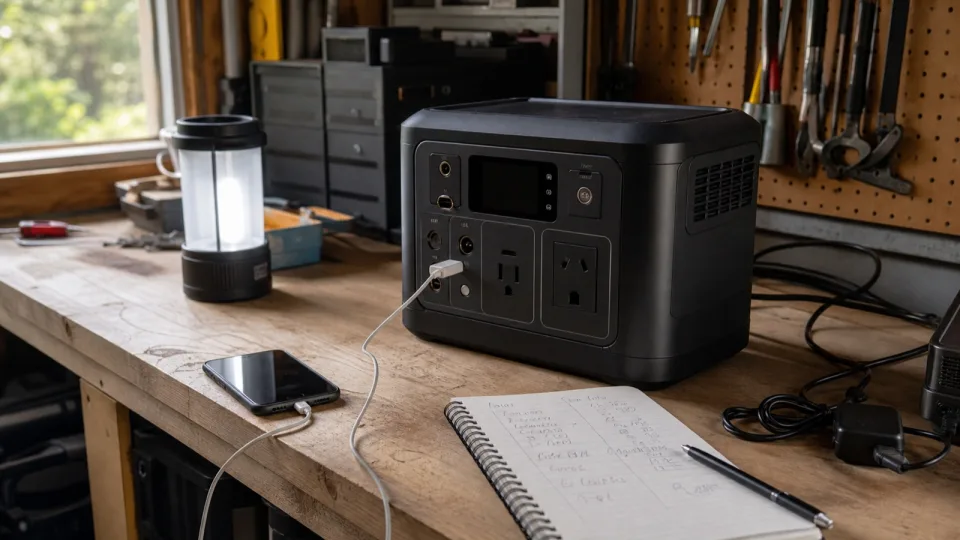
A CPAP outage plan is more than owning a charged battery. You need the correct cable, enough tested runtime, a way to recharge, people to call, and a fallback if the plan fails. Use this checklist before storm season, travel, or a planned shutoff.
The FDA advises users of powered home medical devices to know what to do if a device fails, keep supplier and medical contacts, follow the manufacturer’s directions, and maintain backup supplies. This checklist organizes that work, but it does not replace advice from your clinician or equipment provider.
Record the exact setup
Do not let “CPAP” be the only description in the plan. Write down:
- Machine manufacturer, exact model, and serial number.
- Prescribed mode and settings, without changing them for battery life.
- Mask, humidifier setting, heated tube setting, and any other powered accessory.
- Power-supply model and electrical ratings.
- Manufacturer-approved AC or DC connection and the exact cable part number.
- Normal sleep hours and number of nights required before recharge.
- Full-night measured watt-hours or the exact manufacturer battery-table entry.
Keep the device manual and battery instructions with this page. ResMed’s battery guide, for example, uses model-, pressure-, accessory-, and connection-specific tables. Another model needs its own documentation; copying a ResMed result is not a valid shortcut.
If the power station has not been chosen yet, calculate capacity with the CPAP power-station sizing guide, then check the result in the CPAP runtime calculator.
Build the communication and fallback plan
Write these numbers on paper in case a phone is dead:
- Clinician and after-hours medical contact.
- Home medical equipment provider or distributor.
- CPAP manufacturer support.
- Electric utility outage line and account number.
- A nearby person who can help with transport or charging.
- Local emergency services and the circumstances in which your clinician says to use them.
Ask the equipment provider whether your exact device can use a battery or generator, which adapters are approved, and whether any setting or alarm behavior changes after loss of power. If interruption is a serious medical risk, define a relocation or emergency plan with the care team instead of making the consumer battery the only layer.
The FDA’s home-device checklist says to have a backup plan and supplies and to educate family or caregivers about the device. Make sure another person can find the cable, start the station, read its warnings, and follow the fallback instructions.
Rehearse the real connection
Complete a controlled rehearsal while normal power and assistance are available:
- Fully charge the power station and inspect the CPAP, power supply, cable, and battery for damage.
- Connect the equipment exactly as both manufacturers direct.
- Use the normal prescribed configuration for a representative session.
- Confirm the station stays on during low-load periods and the CPAP shows no power error.
- Record starting and ending battery percentage, elapsed hours, and any alarms.
- Restore normal power and confirm the CPAP settings did not change.
Do not repeatedly unplug a medical device, improvise adapters, or defeat alarms to force a test. Stop if either manual warns against the arrangement or the equipment behaves unexpectedly.
A successful rehearsal is evidence about that date and setup, not a permanent guarantee. Battery capacity changes with age, storage state, and temperature.
Protect the CPAP reserve
Label the outlet or battery port reserved for the CPAP. Phones, lights, a router, and a fan can consume the margin silently. If they must share the same station, include them in the outage backup load planner and size the system for the combined load.
Write down the recharge order:
- Wall charging before a forecast event.
- Vehicle charging limits and where the vehicle can be operated safely.
- Generator location and carbon-monoxide precautions from its manual.
- Solar panel compatibility, realistic input, and time available in daylight.
Never operate a fuel-burning generator indoors, in a garage, or near openings. A portable solar panel may extend an outage plan, but weather and the station’s input limit can prevent a same-day refill. Check conservative inputs with the solar recharge time calculator.
Put the checklist on a schedule
Add a recurring calendar reminder to:
- Charge the station to the manufacturer’s recommended storage level.
- Inspect cables and ports for damage or corrosion.
- Check for device, cable, or battery recalls.
- Confirm emergency contacts and the fallback location.
- Repeat the runtime rehearsal at the interval recommended by the battery manufacturer and after any equipment or therapy change.
- Replace any item that no longer reaches the recorded reserve.
Keep the battery dry, within its stated storage-temperature range, and away from a humidifier water spill. Follow its manual for long-term state of charge; storage guidance is not identical across battery products.
Next action: print or save this checklist offline, fill every blank for the exact CPAP setup, and schedule the first controlled rehearsal before the next likely outage.