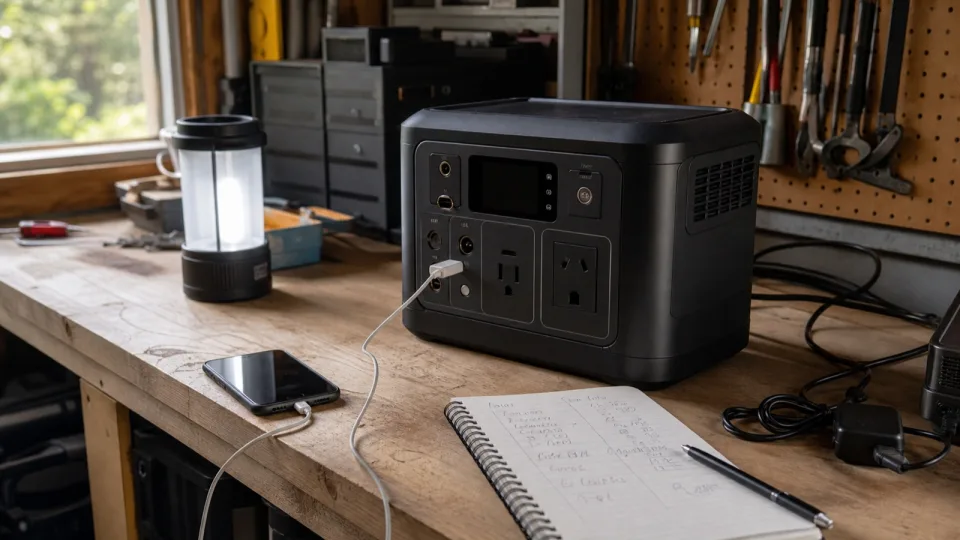
Yes, a portable power station can run many CPAP setups overnight, but only when it passes four separate checks: usable energy, output compatibility, connection compatibility, and an actual rehearsal. A product page saying “runs a CPAP” does not answer any of them for your machine.
This is a fast feasibility check, not medical advice or a guarantee of therapy continuity. If losing therapy is medically serious for you, make the outage plan with your clinician or equipment provider.
Check 1: Does it hold enough usable energy?
The cleanest input is watt-hours measured over a normal full night with your usual prescribed settings and accessories. A single watt reading can miss heater cycling or pressure changes. If measurement is not available, use the exact manufacturer’s battery guide for the machine, pressure, humidifier, heated tubing, and cable.
For a one-night estimate:
overnight load (Wh) = average watts x sleep hours
usable station energy (Wh) = labeled Wh x delivery efficiency x planned usable fraction
The station passes the energy check only when usable station energy is greater than the overnight load.
Hypothetical example:
- Station label: 500Wh
- AC delivery assumption: 85%
- Planned usable fraction after keeping 20% reserve: 80%
- Usable planning energy:
500 x 0.85 x 0.80 = 340Wh - Measured CPAP setup: 32W average for 8 hours, or
256Wh
That example clears the planning check with 84Wh left. A 45W setup would need 360Wh and would fail under the same assumptions. This is why a battery class cannot answer the question by itself.
Enter the actual figures in the CPAP runtime calculator. For multiple nights or a new purchase, use the full CPAP power-station sizing guide.
Check 2: Can the station operate the complete setup?
Capacity is only the duration check. The power station must also satisfy the electrical instructions for the CPAP and every heated accessory.
Confirm:
- Continuous output is above the complete setup’s documented requirement.
- The AC output or manufacturer-approved DC converter matches the machine.
- Voltage, polarity, and connector are correct; never choose a cable only because the plug fits.
- The station does not shut its output off automatically when the CPAP draw becomes low.
- The machine retains the prescribed settings after power is removed and restored.
ResMed’s battery guide separates converter and inverter arrangements and gives model-specific tables. It also shows large differences between configurations with and without heated humidity. ResMed separately recommends consulting that guide and turning humidification off when using a battery for the Air series. That is manufacturer guidance for those products, not permission to change a prescribed setup without discussing comfort or clinical needs with your provider.
Check 3: Does the whole night match the claim?
Runtime advertisements often omit the assumed machine, pressure, heated features, battery reserve, and AC-versus-DC path. Ignore a “nights of CPAP” claim unless all of those inputs are disclosed and match your use.
A controlled rehearsal is more useful. Before an outage, charge the station fully and follow both manuals to power the CPAP exactly as planned. Rehearse the connection and observe the remaining battery after a normal session while regular power and help are available. Do not alter therapy settings for the test. If the station turns off, alarms, overheats, or leaves less reserve than planned, it did not pass.
Testing one night still does not turn a consumer battery into a medical-grade backup system. Battery state, temperature, aging, and settings can change the next result.
Check 4: What happens if it does not last?
The FDA recommends that users of powered home medical devices read the instructions, ask the distributor or manufacturer about battery or generator use, check cords and batteries, and have a backup plan. Write down your equipment provider, clinician, manufacturer support, utility outage number, and the point at which you would relocate or seek help.
Also decide how the station will be recharged. A full battery tonight does not solve tomorrow night’s outage. The CPAP outage checklist turns that into a repeatable readiness check, and the outage load planner can include a phone, router, light, or other essential loads without quietly stealing CPAP reserve.
Next action: measure or document one night’s CPAP energy, run the four checks, and complete a normal-use rehearsal before counting the station as part of your outage plan.