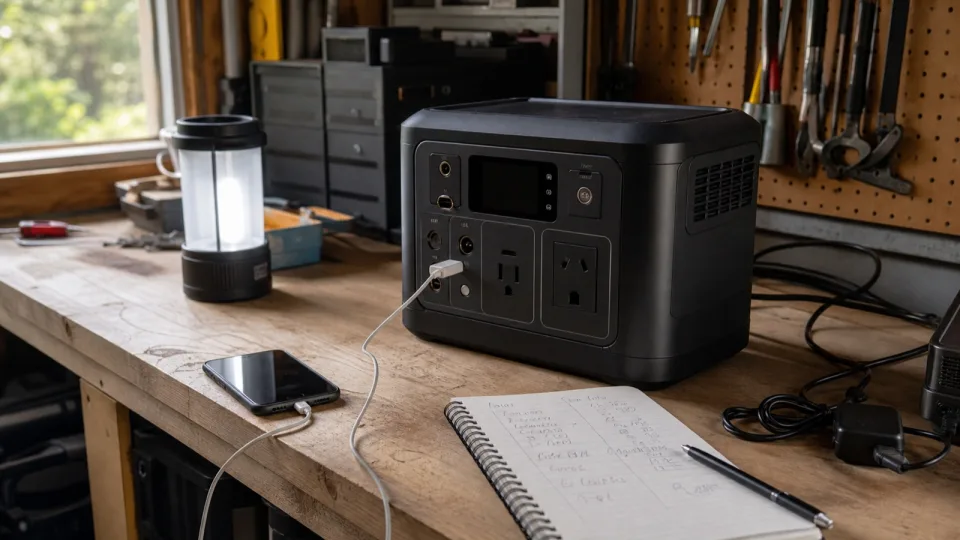
Running a CPAP from a power station’s AC outlet and running it through an approved DC converter are two different power paths. The DC path can avoid the station’s inverter and the CPAP’s AC power supply, but that does not support a universal claim that it adds a certain percentage of runtime.
The actual difference depends on the power station, the exact CPAP configuration, the converter, humidification, heated tubing, pressure, and overnight operating conditions. Compatibility comes first. Runtime comes second.
This page is a purchase-planning guide, not medical advice or a guarantee of backup reliability. If losing power to the device presents a serious health risk, work with the clinician or equipment provider on an appropriate contingency plan.
Understand the two power paths
With the original AC adapter, the power path is generally:
power-station battery -> AC inverter -> CPAP power supply -> CPAPWith a documented DC converter, it is generally:
power-station battery -> DC output -> approved converter -> CPAPEvery active conversion stage uses some energy, so bypassing an inverter may improve total delivery efficiency. The size of that improvement cannot be inferred from the words “pure sine wave,” a station’s capacity label, or a cable listing. Inverter behavior varies by station, and a converter has losses of its own.
The useful comparison is full-night energy drawn from the same station while the CPAP uses the same therapy and climate-control settings. If direct measurement is not available, use documented figures from the manufacturers and leave a larger reserve.
Compare AC and DC with transparent assumptions
Begin with usable delivered energy, not the full capacity printed on the battery:
usable delivered Wh = labeled Wh x delivery efficiency x usable fraction
runtime hours = usable delivered Wh / measured average watts
Consider a hypothetical 500Wh station. Suppose a planning exercise uses an 85% AC delivery efficiency, a 92% DC delivery efficiency, a 20% reserve, and a hypothetical 30W average device load.
For the AC path:
500Wh x 0.85 x 0.80 = 340Wh delivered
340Wh / 30W = 11.3 hours
For the DC path:
500Wh x 0.92 x 0.80 = 368Wh delivered
368Wh / 30W = 12.3 hours
In this invented scenario, the difference is about one hour. Change either efficiency assumption and the result changes. These figures are not measurements of a ResMed converter, a particular power station, or a typical CPAP. They simply show how to compare two paths without hiding the assumptions.
Enter measured or manufacturer-supported values in the CPAP power station runtime calculator. Then use the power-station sizing guide for CPAP to account for multiple nights, reserve, and recharge time.
Verify the exact converter and machine
A plug that fits is not proof of electrical compatibility. Check the complete model number and the manufacturer’s current documentation before connecting a medical device to a DC source.
For example, ResMed publishes a dedicated user guide for its Air10 and S9 90W DC/DC Converter. That guide identifies the products and electrical conditions it covers. It does not establish compatibility with every ResMed machine, every third-party cable, or every power-station port.
Verify all of these details:
- The converter is specified for the exact CPAP model.
- The station’s DC port supplies the input voltage and continuous current required by the converter.
- Connector shape, polarity, and any model-specific communication are correct.
- The converter and station can be placed with the ventilation and moisture clearances required by their manuals.
- The station does not disable its DC output at the overnight load.
- Heated tubing and humidification are included in the energy estimate if they will be used.
Do not substitute an unverified passive cable because its barrel connector looks correct. Do not assume a marketplace compatibility list overrides the CPAP manufacturer’s documentation.
Know when AC is the practical choice
AC may be the better-supported path when the original power supply is the only connection documented for the setup, when no approved DC converter is available, or when the station’s DC port cannot meet the converter requirements. A modest theoretical efficiency gain is not worth using an uncertain connection.
AC also provides a straightforward baseline for measurement. Record the station’s starting and ending energy, or use its energy display if the manual explains what that display measures. Repeat the same normal overnight setup through the approved DC path. Because pressure and heater demand can vary, more than one comparable night gives a better planning input than one instant watt reading.
The overnight CPAP feasibility guide explains the other checks that a runtime number can miss, including output limits and reserve.
Plan for outages, not just conversion efficiency
Whether the connection is AC or DC, verify the arrangement before it is needed. Confirm that the station remains on, the device starts normally, the cable cannot be pulled loose, and enough capacity remains after a normal session. Also document how the station will be recharged if the outage lasts longer than one night.
The FDA advises users of powered medical devices to understand what a power loss means for the equipment, read the instructions, keep supplier and emergency contacts available, and check device settings when power returns. Use the CPAP outage backup checklist to keep those operational details with the equipment.
Bottom line: an approved DC converter may reduce conversion overhead, but the gain is specific to the equipment. Verify compatibility first, compare full-night watt-hours under the same settings, and size the backup with enough reserve that the plan does not depend on an optimistic efficiency estimate.