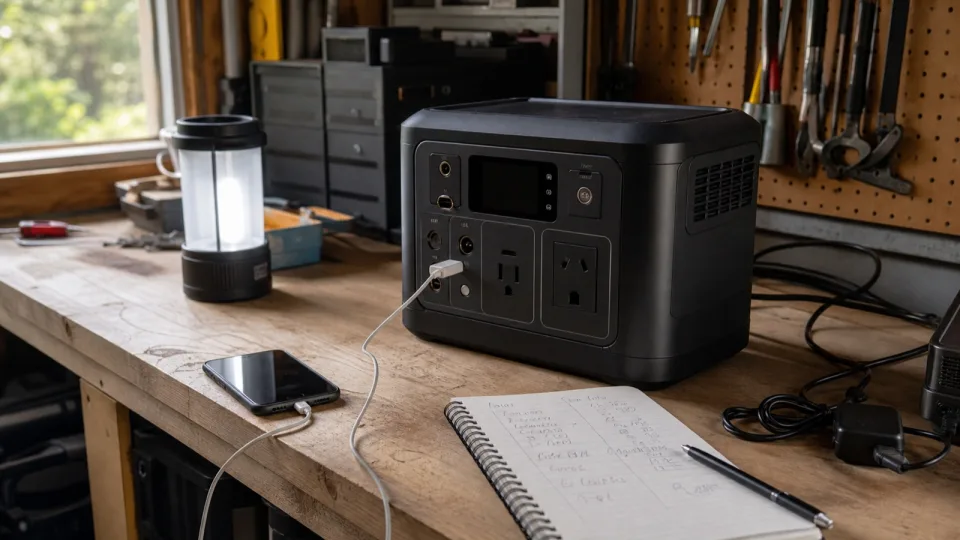
A 300Wh class station is the light-load choice, 500Wh class adds runtime without jumping to a large battery, and 1000Wh class is the first of these three that comfortably covers many all-day or mixed-load plans. That is only a starting point. The right size is the smallest actual model whose nameplate watt-hours meet your calculation and whose inverter can start and continuously run the load.
Do not choose from the class name alone. Current products prove why: EcoFlow lists the RIVER 2 at 256Wh and 300W AC output, while its RIVER 2 Pro is 768Wh and 800W. Jackery lists the Explorer 1000 v2 at 1070Wh and 1500W. Capacity and output are separate specifications, and the number in a product name may not equal either one.
Runtime comparison using the same assumptions
For a constant AC load, this first-pass formula is useful:
Estimated runtime (hours)
  = battery nameplate Wh x delivered-energy fraction / load watts
The table below uses an illustrative 85 percent delivered-energy fraction. It is not a measured result for every station. Inverter loss, inverter idle draw, battery reserve settings, temperature, battery age, and load behavior can all change the outcome.
| Nominal shopping class | 40W constant AC load | 100W constant AC load | Best starting point for |
|---|---|---|---|
| 300Wh | 6.4 hours | 2.6 hours | Phones, lights, routers, laptops, and other modest loads |
| 500Wh | 10.6 hours | 4.3 hours | Longer light-load runtime or a larger reserve |
| 1000Wh | 21.3 hours | 8.5 hours | All-day loads, several essentials, or more time before recharge |
These are calculations, not product tests. Enter the exact capacity and your own load in the power station runtime calculator to replace the table’s round numbers.
Round the requirement up, never down
Suppose a device averages 80W and must run for eight hours:
Energy delivered to the device = 80W x 8h = 640Wh
Required nameplate capacity = 640Wh / 0.85 = 753Wh
A 700Wh shopping bucket is too small because the calculation is 753Wh. The next bucket is 1000Wh. A specific 768Wh model technically clears the calculated minimum on paper, but only by 15Wh; it leaves almost no room for a higher load or a worse efficiency result. The final check is always the model’s actual nameplate capacity, not the search term used to find it.
Use these upward-only shopping ranges after calculating required nameplate energy:
| Calculated minimum | First shopping bucket to compare |
|---|---|
| Up to 300Wh | 300Wh class |
| More than 300Wh, up to 500Wh | 500Wh class |
| More than 500Wh, up to 700Wh | 700Wh class |
| More than 700Wh, up to 1000Wh | 1000Wh class |
| More than 1000Wh, up to 1500Wh | 1500Wh class |
| More than 1500Wh, up to 2000Wh | 2000Wh class |
| More than 2000Wh, up to 3000Wh | 3000Wh class |
If the result exceeds 3000Wh, compare larger or expandable systems rather than forcing it into the 3000Wh bucket. If an exact product in a class has less capacity than your result, it does not qualify.
Capacity answers how long; output answers whether
Watt-hours estimate duration. Continuous AC watts determine whether the station can keep a device running. Startup or surge capability matters for compressors, pumps, and some tools.
Check all three on the manufacturer’s current specification page or manual:
- Nameplate capacity in Wh: must meet the runtime calculation.
- Continuous output in W: must exceed the combined watts of everything running at once.
- Startup capability: must meet the appliance’s documented or measured starting demand under the manufacturer’s stated surge conditions.
A battery can contain enough energy for a refrigerator and still fail to start its compressor. Conversely, a station can have a powerful inverter and too little capacity for the desired runtime. For a cycling appliance, use the refrigerator and freezer outage backup calculator instead of treating its running watts as a constant 24-hour load.
What each size changes in practice
300Wh class: prioritize portability and a short load list
This class makes sense when the calculated requirement is at or below 300Wh and every load fits the output limits. It is easier to carry and quicker to refill from the same charger because there is less energy to replace. The tradeoff is limited reserve. A few extra hours, a heated accessory, or leaving the AC inverter on can matter.
Before buying, calculate one device at a time. A compact station may be a good fit for DC or USB charging yet a poor fit for a motor load even when the watt-hour arithmetic looks adequate.
500Wh class: buy it for a measured middle-size requirement
The 500Wh bucket is useful when the minimum lands above 300Wh but no higher than 500Wh. It is not automatically a universal “sweet spot.” If your math says 556Wh, a 500Wh unit is undersized and you should move to the 700Wh bucket.
This is also where exact model specifications become especially important. A listing described informally as “500 class” may have materially less or more than 500Wh, and inverter output can vary independently.
1000Wh class: more runtime creates a bigger recharge job
A 1000Wh-class search is appropriate when the calculation exceeds 700Wh but stays at or below 1000Wh. It can also provide headroom for uncertain loads, but unused headroom costs money and adds weight.
The other side of a larger battery is recharge time. If a 1000Wh battery supplies 700Wh during an outage, that energy must come back from the wall, vehicle, generator, or solar before the next cycle. Use the solar recharge time calculator with the station’s maximum solar input, the panel rating, and realistic sun assumptions.
Use measured energy when the load changes
The simple runtime formula works best for a steady load. It becomes less reliable when a device cycles, changes modes, or has a heater:
- Refrigerators and freezers cycle with room temperature, door openings, and thermostat settings.
- CPAP energy can change with pressure, mask leak, humidification, and heated tubing.
- Laptops and game systems change draw with workload and charging state.
- AC inverter idle consumption matters more when the connected load is small.
Use an outlet energy meter over a representative period when practical. If a device reports energy in kWh, multiply by 1000 to convert it to Wh before comparing it with battery capacity.
Decision checklist
- Measure or document the load’s average watts and startup demand.
- Multiply average watts by required hours.
- Divide by your stated delivered-energy fraction or enter separate efficiency and reserve inputs in a calculator.
- Round up to the first shopping bucket that is not smaller than the result.
- Reject any exact model whose actual Wh, continuous output, or startup capability misses a requirement.
- Check how the energy will be replaced before the next use.
Next action: run the exact load through the power station size calculator, then compare only models whose published capacity and output clear every result.
Disclosure: As an Amazon Associate I earn from qualifying purchases.
Compare listings after doing the math
Amazon listings are useful for availability, not final specification verification. Confirm the exact model number, capacity, continuous output, startup behavior, charging limits, included cables, and warranty on the manufacturer’s current page or manual.