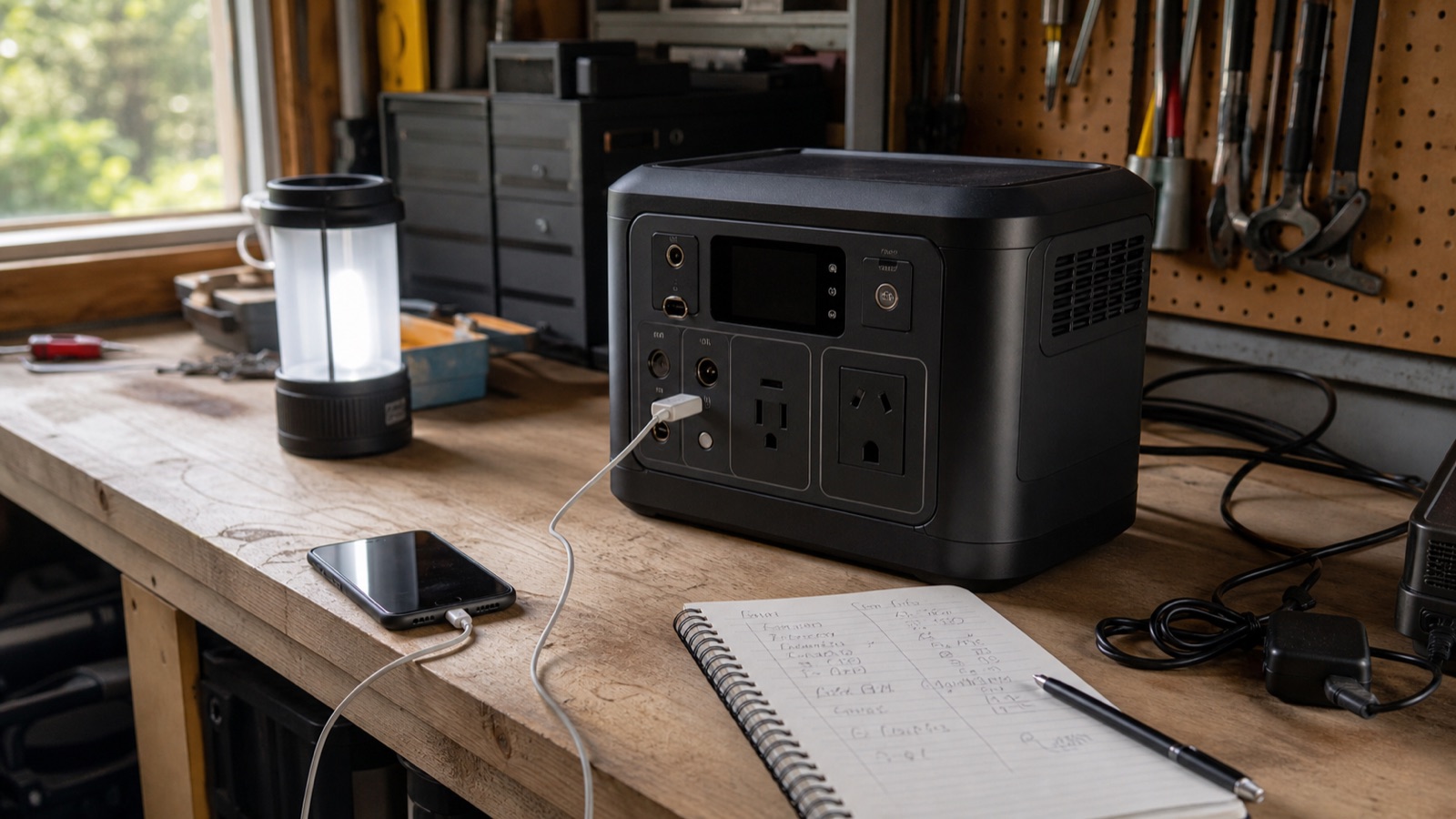
Most shoppers get hung up on watt-hours (Wh) because the number is easy to compare. Bigger number, more power, right? Yes—and also more weight, more cost, and more capacity you might never use. The real decision is which size matches your actual gear and habits. Below, we break down what 300Wh, 500Wh, and 1000Wh mean in terms you can check against your own stuff.
What Wh actually tells you (and what it doesn’t)
A 300Wh station can, in theory, run a 300W appliance for one hour—or a 50W appliance for about six hours. Reality is messier. Inverter losses, temperature, and age eat into that number. Assume you’ll get 80–90% of the label, not 100%.
More important: watt-hours don’t tell you what the station can start. A mini-fridge might only pull 60W running, but need a 300W surge to kick on. If your 300Wh station has a 200W inverter, it won’t start the fridge. Always check continuous watt rating and surge rating, not just Wh.
300Wh: the weekend helper
- Typical output: 200–300W continuous, maybe 500W surge.
- Weight: Around 7–10 lbs.
- Realistic uses: Keep a CPAP running one night (with humidifier off), charge phones and tablets for a few days, run a small LED light strip, power a 12V cooler box intermittently.
- Won’t do: Most cooking appliances, full-size fridges, power tools bigger than a cordless drill charger.
This size shines for solo campers, tent setups, or desk-side backup during short outages. It’s easy to carry and charges fast from a 100W solar panel. But if you need to run anything with a compressor or heating element, you’ll hit the wall quickly.
500Wh: the middle child that fits many use cases
- Typical output: 300–500W continuous, often 600–1000W surge.
- Weight: 12–15 lbs.
- Realistic uses: CPAP for two nights, a 12V fridge for 8–12 hours, charge a laptop several times, run a small fan, or keep a home router alive during a workday outage.
- Won’t do: Most microwaves, space heaters, or hair dryers—unless the surge rating is unusually high and you’re careful.
500Wh is often the sweet spot for couples camping or single-person backup. You can pair it with a 200W solar setup and stay topped off indefinitely in good sun. Watch the inverter rating: some 500Wh units still cap at 300W, which won’t handle even a modest appliance.
1000Wh: the heavy lifter with tradeoffs
- Typical output: 1000–1500W continuous, often 2000W+ surge.
- Weight: 20–30 lbs.
- Realistic uses: Run a blender or small microwave (3–5 minutes), power a full-size fridge for 8–14 hours, run a TV and game console for a long evening, keep a workstation (monitor, laptop, light) going all day.
- Won’t do: Whole-house backup, well pumps, electric heaters for more than a few minutes.
This class starts to overlap with home backup—but don’t mistake it for a generator. It’s still a portable battery. The extra capacity means slower solar charging unless you have multiple panels and good sun. Weight also matters: 30 lbs is no longer “toss it in the trunk casually.” If you’re rarely pulling high watts, the extra Wh add cost without daily benefit.
The math you should do before shopping
Grab your devices and look at labels. If a label shows amps and volts, multiply them to get watts: A × V = W. So a 2A, 120V appliance pulls 240W. Estimate hours of use per charge: W × hours = Wh needed. Then add 20% for inverter loss and battery aging. That’s your minimum station size.
Example: CPAP (50W average) × 8 hours = 400Wh. Add 20% → 480Wh. A 300Wh station might barely make it with humidifier off; a 500Wh unit gives margin.
Charging speed matters as much as capacity
A big battery you can’t recharge fast is dead weight on day two. Most stations list max solar input (in watts) and AC charge time. Rough rule: in full sun, a 100W panel might add 70–80W net per hour. So charging a 500Wh station from zero takes about 6–7 hours on a 100W panel. A 1000Wh station might take 12+ hours on the same panel. Check if the station supports parallel solar panels to speed this up—many in the 500Wh+ class do.
What to ignore on the sales page
- “Days of power” without specifying load. Meaningless.
- “Enough to charge a phone 50 times.” Phone batteries vary. Look for Wh specs instead.
- “Survival kit” or “emergency must-have” language. Focus on what it powers and for how long.
- Marketing photos showing the station running a space heater and AC and fridge simultaneously. Check the inverter limit.
Verification notes
- Manufacturer Wh ratings are often measured under ideal lab conditions. Search forums or YouTube for “actual capacity test” with the model you’re eyeing to see what real users get.
- Inverter surge ratings (e.g., “1000W surge”) might only hold for a fraction of a second. If you need to start motors, look for sustained surge duration in the manual—often a few seconds matters.
- Solar input ratings often assume an open-circuit voltage near the max limit. Mixing panels can confuse the MPPT controller. Stick to identical panels if possible.
Claims to double-check
- “Pure sine wave” claims: Most modern stations include pure sine wave inverters, but budget models sometimes use modified sine—which can make motors buzz and some electronics unhappy. Verify in specs.
- “LiFePO4 battery”: This chemistry is often marketed for longer cycle life and better thermal stability than some other lithium chemistries. Verify the stated cycle life, warranty length, and operating temperature range in the manufacturer specs.
- Pass-through charging: If you want to use the station as a UPS (plugged in while powering devices), confirm it supports pass-through without battery drain or rapid cycling. Not all do.
Disclosure: As an Amazon Associate I earn from qualifying purchases.
Compare current Amazon listings
These links are a starting point for checking current listings. Verify model numbers, specs, warranty terms, and seller details before buying.